Map the clothes you reach for
Start with an ordinary week, not an idealized wardrobe. Which garments are worn repeatedly? Which need hanging, and which are happier folded? Put the repeated choices where they can be seen and reached comfortably. Occasion clothing can occupy less convenient space, provided it remains protected and retrievable. This small hierarchy often frees useful room without removing any clothing or installing another fitting.
Watch how the wardrobe opens. Sliding doors expose only part of the interior at once. Hinged doors may collide with a bed or block a drawer. A storage accessory that fits inside the cabinet can still fail if it cannot be pulled through the available opening. Measure the route outward, including handles, door edges, skirting boards and anything normally left on the floor nearby.
Compare what each organizer gives up
A fabric hanging organizer converts some rail width into small shelves. It can help a wardrobe that has hanging space but no drawers. However, it also concentrates weight on the rail and may sag when overfilled. Check both the organizer’s capacity and the wardrobe’s instructions. Use it for light categories such as T-shirts rather than assuming every compartment can carry a heavy stack of denim.
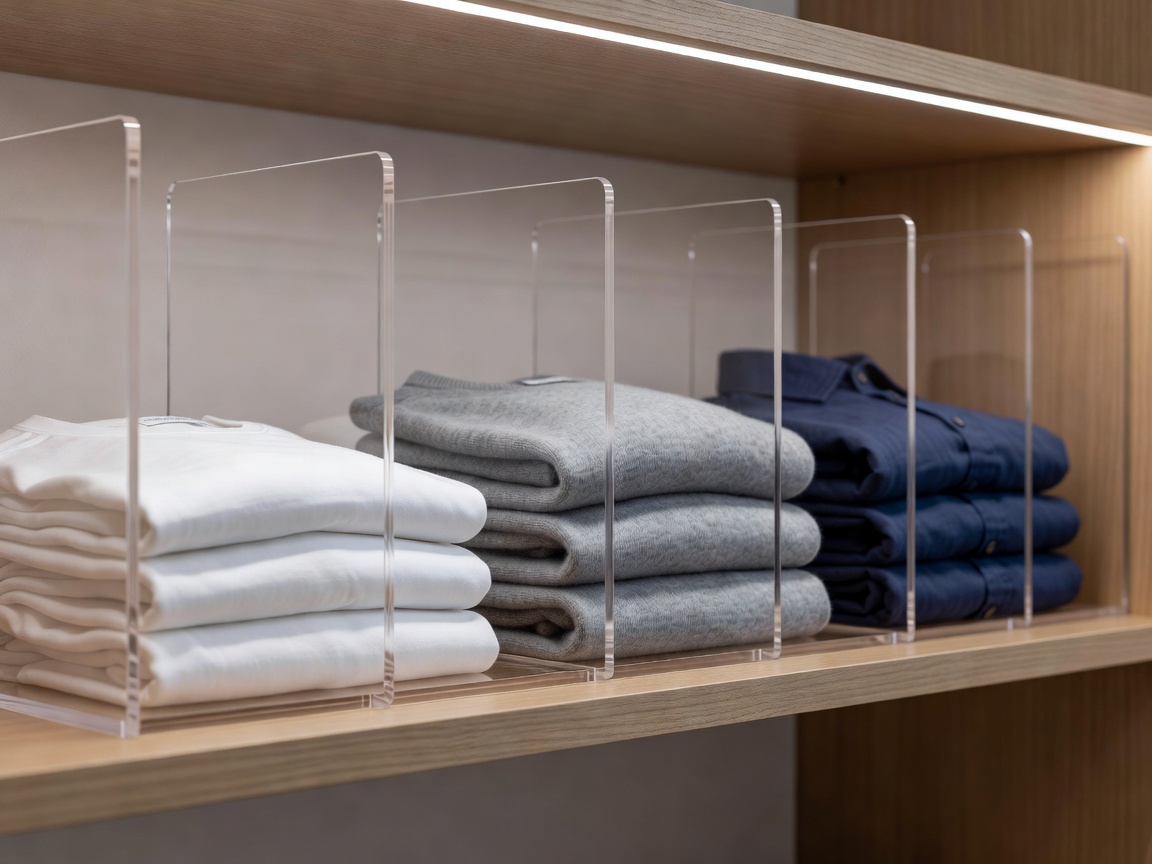
Shelf dividers make existing shelves more usable without adding a whole compartment. They are particularly helpful for separating short folded stacks or keeping bags upright. Measure shelf thickness and confirm the fitting method. Clip-on models may not suit every shelf edge, and adhesive versions may mark a finish. In a rental, obtain permission before altering fixtures and check removal instructions rather than trusting a broad “damage-free” claim.
Slim hangers can reduce the thickness taken up by the hangers themselves, but clothing still needs room to move. Overpacking a rail makes garments harder to remove and can cause wrinkling. Some shaped jackets need broader support than a thin hanger provides. Keep suitable existing hangers where they already work; replacing every hanger for appearance alone is not a necessary first step.
| Option | Useful when | What to watch |
|---|---|---|
| Hanging organizer | Rail space exceeds shelf space | Lost rail width; sagging; load limits |
| Shelf divider | Stacks collapse sideways | Fit on shelf edge; inaccessible deep rows |
| Drawer divider | Small garments become mixed | Overly narrow compartments |
| Under-bed drawer | Floor clearance and pull-out room are available | Bed legs; dust; loaded rolling resistance |
| Zipped fabric bag | Light seasonal textiles need occasional access | Weak handles; damp conditions; awkward lifting |
Under-bed space is not automatically convenient
Measure the lowest obstruction under the bed, not just the visible frame edge. A central support or sloping base can reduce clearance. Then measure the space beside the bed: a drawer needs somewhere to travel. Include the height of wheels, the lid and any raised handle in the product dimensions. Where possible, try a cardboard outline on the floor before ordering.
Wheeled rigid drawers usually make retrieval easier on a suitable floor, but soft carpet can resist small wheels. Fabric bags are lighter and can fit irregular gaps, yet they may require kneeling, pulling and lifting. Choose according to the user’s comfortable movement. If bending to floor level is difficult, this area may be better reserved for infrequent belongings rather than daily clothing.
Store only clean, fully dry textiles, and follow garment care instructions. Do not block ventilation needed by the bed or mattress system. Avoid assuming that a zipped bag provides moisture control. If the area smells damp, address the cause before storing anything there. Leave inspection and cleaning possible instead of filling every gap with tightly packed bags.
“A hidden space is useful only when what you put there can come back out.”
Systems are examples, not universal answers
IKEA PAX and BOAXEL, Elfa, and ClosetMaid illustrate different approaches to fitted interiors, wall-mounted storage and adjustable components. Their configurations are not interchangeable. Check the exact model, fixing requirements, wall suitability and local availability. We have not load-tested these systems or ranked their durability. A freestanding insert may be simpler than a fitted system when household needs or tenancy arrangements are likely to change.
Make the return journey easy
A clothing system must work when laundry is clean but time is short. Broad categories often survive better than elaborate subdivisions. If folding is the bottleneck, experiment with fewer stacks or a simple open bin for appropriate garments. If an item never returns to its assigned place, move the place before blaming the habit. The most useful wardrobe is one the household can maintain on an unremarkable evening.
For a lighter starting point, follow our one-category decluttering approach. It can reveal that an organizer is unnecessary—or show exactly which one would help.