Organize around the next meal
Begin with the ingredients you repeatedly use, not a photograph of someone else’s pantry. Put breakfast foods, quick meal staples or baking ingredients together if that follows your cooking habits. Other households may prefer categories such as grains, tins and snacks. Either approach can work. The useful test is whether a person preparing food can find what they need without searching across several unrelated shelves.
Remove one shelf’s contents and check what is already there before drawing up a shopping list. Look for opened duplicates and packets hidden behind taller objects. Follow the storage instructions on each product and distinguish food-safety information from a general tidiness decision. A pantry reset is not a reason to keep food that should be discarded, nor to discard suitable food merely because the packaging looks untidy.
Clear containers earn their place selectively
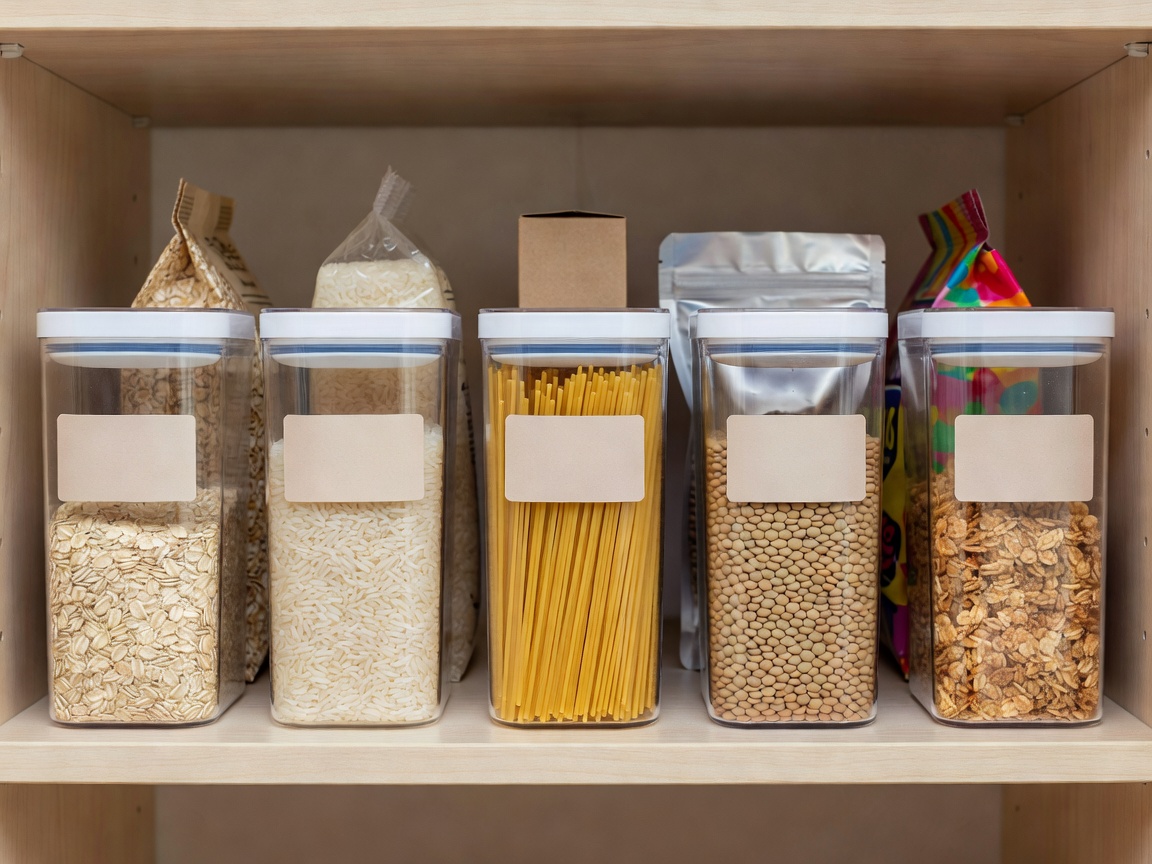
Decanting is most useful for staples used repeatedly from awkward packaging. A container with a wide opening may make flour easier to scoop; a transparent wall can show when rice is running low. But every transfer adds washing, drying and labeling. For an ingredient used infrequently, keeping the original package in a shallow bin may preserve information and save work.
If you transfer food, use a container intended for the relevant food-contact use and follow its care instructions. Keep the product name, allergen statement, cooking directions, date information and batch details available. A photograph can help preserve information, but it should remain easy for everyone preparing food to locate. Never rely on memory alone where similar-looking ingredients or allergens could cause confusion.
Avoid endlessly topping up an old supply with a new one. Finish or appropriately separate the existing contents, then clean and fully dry the container as directed before refilling. Label the new contents accurately. “Airtight” describes a claimed seal, not a promise that every food can be stored anywhere or indefinitely. Heat, light, moisture and the food’s own instructions still matter.
| Product | Strongest use | Possible drawback | Key check |
|---|---|---|---|
| Clear dry-food container | Frequently used dry staples | Transfer and cleaning effort | Food-contact suitability; seal; scoop access |
| Handled packet bin | Grouping original packages | Deep bins hide small packets | Visibility and comfortable loaded weight |
| Shelf riser | Showing shorter jars behind a front row | Can crowd tall items | Stability and remaining shelf clearance |
| Turntable | Small bottles in a deep corner | Round footprint leaves unused corners | Rotation clearance; retaining rim |
Test a riser or turntable before adding a set
A shelf riser can reveal labels at the back, but it also consumes vertical space. Measure the height of the tallest item on the raised level and allow room to lift it free. Put heavier containers where they are stable and manageable. A riser that creates two cramped levels may be less useful than one clearly visible row with a little open space above it.
A turntable makes some corner cupboards easier to use because the contents move toward you. It is less efficient for square packets and can waste the corners of a rectangular shelf. Try arranging the intended bottles inside a paper circle of the proposed diameter. Make sure handles, cupboard walls and neighboring objects will not block rotation. Avoid storing hazardous household chemicals alongside food simply because a shelf has spare capacity.
Compare examples by their exact specifications
OXO POP, Rubbermaid Brilliance and IKEA 365+ are examples of food-container ranges a reader may encounter. They are not interchangeable, and we have not tested their seals or longevity. Check the exact product’s material, care directions, intended use and available sizes. A family name is not proof that every item in that range is freezer-safe, dishwasher-safe or suitable for every kind of food.
Use reliable food guidance when needed
USDA FoodKeeper and the UK Food Standards Agency provide food-storage guidance for their respective audiences. Consult current official guidance and the product label for your circumstances, especially where refrigeration, use-by dates or vulnerable household members are involved. Our comparisons address organization and access; they are not a substitute for food-safety advice. Requirements and terminology can differ by jurisdiction.
Finish by making a small “use next” area for suitable food that needs attention, while respecting its storage instructions. Review it before shopping. If the pantry becomes easier to scan and the household buys fewer accidental duplicates, the arrangement is doing useful work—even if most of the food remains in its original packaging.
For broader guidance on buying less storage, read Less Sorting, Easier Living.